Showing posts with label United Kingdom. Show all posts

Friday, 24 June 2016

EU Referendum: Statement by HG Bishop Angaelos


Statement by His Grace Bishop Angaelos, General Bishop of the Coptic Orthodox Church in the United Kingdom, following the results of the EU Referendum

24 June 2016

Over this past week, the United Kingdom has experienced a series of significant, challenging and sometimes painful milestones. With the long-awaited results of the EU referendum, and the tragic death of Jo Cox MP in the lead-up, emotions are high and there is potential for hostility and divisiveness to flourish. There is however the more positive outcome, that these events serve as a catalyst for a greater unity and a collective stance for the good of all.

While Jo’s tragic and wasteful death was unequivocally horrific and heart-breaking, it also gave rise to overwhelming acts of generosity from the general public and unrivalled comradery in the Houses of Parliament. This tragedy also sparked a significant conversation on the importance of solidarity and indiscriminate compassion for humanity, with the hashtags #LoveLikeJo and #MoreInCommon emerging to diffuse divisive rhetoric and promote understanding in the public sphere.

It is in this light and sentiment, and with the outcome of the EU referendum, the United Kingdom must now pull together, as it has so often done in the past, despite clear differences in opinion and direction. Division must not be allowed to take hold, and divisive rhetoric must not take root. While many would have preferred to see the UK remain in the EU, now is the time for us all as a nation to accept the decision that we have reached together through the democratic processes we have upheld for centuries, and indeed advocate for across the world. It is important for us to commence the healing process that is needed after these months of committed campaigning, and to comfort all who are now fearful of the future, and suffering the distress of uncertainty, especially due to the immediate effects on the economy.

Regardless of what the future holds for the United Kingdom we can be certain that we are in the hands of a mighty God Who is unchanging and with us throughout our various challenges. It is our role as Christians, not only to be stewards and active citizens within our countries, but to provide holistic support for all who find these events overwhelming and distressing.        

We pray for the Prime Minister, our parliament, and all those entrusted with the leadership of these great nations, confident that the United Kingdom will find a way to embark on this new stage in history, together united.


*Ends*

Wednesday, 19 March 2014

Press Release: HG Bishop Angaelos delivers address at the Houses of Parliament regarding the current situation in Egypt since the 2011 uprising

Press Release
For immediate use
19 March 2014

Coptic Orthodox Church UK
Media and Communications Office

Coptic Orthodox Church (Europe)
Media and Communications Office 

On 17 March 2014 His Grace Bishop Angaelos, General Bishop of the Coptic Orthodox Church in the United Kingdom delivered an address at the Houses of Parliament in Westminster, London, arranged by the Conservative Party’s Middle East and North Africa Group (MENA) regarding the current situation in Egypt since the 2011 uprising.

Addressing an audience comprised of specialists, analysts and enthusiasts with an interest in Egypt and the wider Middle East, Bishop Angaelos highlighted the resilient nature of Egypt’s citizens, and the challenges faced in light of the recent uprisings.

Speaking of proactive steps towards reconciliation and rebuilding Egypt, he said:

 “Reconciliation must happen through pragmatic and intentional leadership; bringing people together. These efforts will then instil a sense of unity, cohesion and national identity so that people no longer focus on one’s religion, but see the Egyptian in the other...It is only then that we can begin to advocate for one another.”

Addressing the misconception that issues in Egypt arise primarily due to a Muslim Christian divide, he said:

“This is about advocating for all; about unity, individual identity, and the importance of that individual as a member of a nation state.”

Raising awareness to the impact of the recent uprisings on Christian and minority communities in Egypt, as well as the state of polarisation affecting the nation, Bishop Angaelos highlighted the increasing levels of poverty and illiteracy, the decline in foreign investment and tourism, the increasing levels of harassment against women, and increasing unemployment.

He went on to provide his optimistic outlook for Egypt and the way ahead however, saying:

“On the 30 June when people took to the streets, they were Christian and Muslim, secular and religious, man and woman, young and old; the whole of society…There is only one way ahead and that is reconciliation, there is no other way. People must live side by side and there must be healing.”

During the course of his address Bishop Angaelos also said:

“We are all held in the hands of a God Who is much more mighty than anyone who tries to create harm….We are confident, through His graciousness, love and vigilance over His whole creation, that God has a solution for Egypt.” 

Among those in attendance were the Chairman and Officers of the MENA Group, Parliamentary Member Mark Field and other representatives of the Conservative Party.

Monday, 7 October 2013

Press Release: Anglican-Oriental Orthodox International Commission reconvenes after 10 years

Press Release
For immediate use
7 October 2013

Coptic Orthodox Church UK
Media and Communications Office

Coptic Orthodox Church (Europe)
Media and Communications Office

ACO/ Neil Vigers

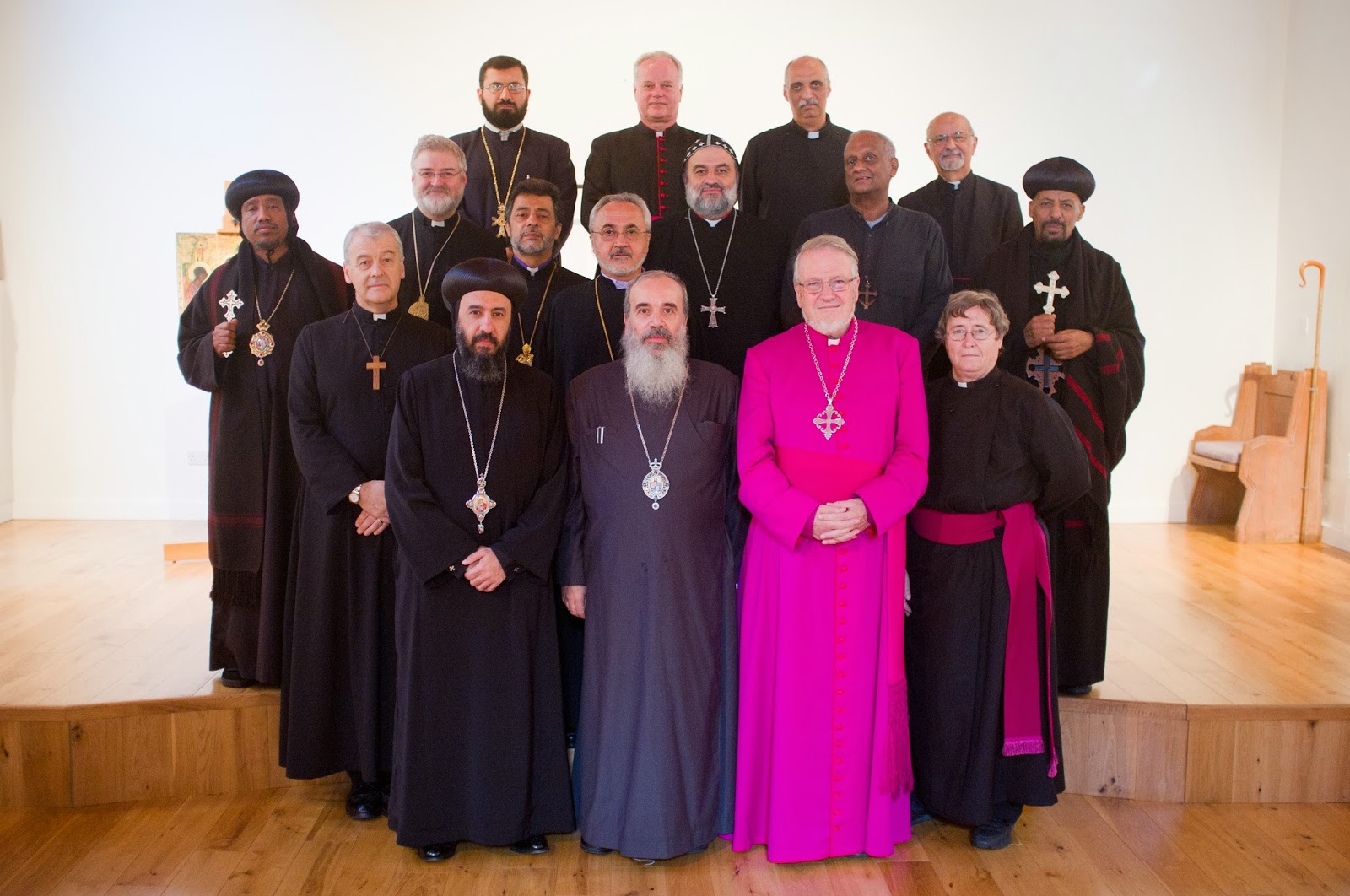
After a ten-year postponement, the Anglican-Oriental Orthodox International Commission held its second meeting 3-7 October 2013 in England.

The Anglican-Oriental Orthodox International Commission met to discuss matters of Christology and the Holy Spirit, and to pray for Egypt, Syria and the wider Middle East during a special service on 5 October 2013. The meeting comes shortly after the visit of the Archbishop of Canterbury, the Most Reverend and Right Honourable Justin Welby to His Holiness Pope Tawadros II, 118th Pope of Alexandria and Patriarch of All Africa on the holy Apostolic See of Saint Mark in Egypt in June of this year.

ACO/ Neil Vigers


His Grace Bishop Angaelos, General Bishop of The Coptic Orthodox Church in the United Kingdom, and acting Co-Secretary of the commission this year said:

“Having reconvened after a long postponement, we met with the aim of continuing our good relations and establishing greater unity between our Churches, while still tackling difficult and challenging issues. This has been an opportunity to re-establish a valuable platform for common understanding, leading to a greater witness of solidarity, not only for members of our own Churches but for the wider Christian Church and the whole world, especially our brethren in Egypt, Syria and throughout the Middle East for whom we prayed.”

Bishop Geoffrey Rowell, Co-Chair of the Dialogue said:

“We rejoice that we have met together once more, here in England, and within this Diocese of Guildford. We have gathered to reflect on our common faith in Christ.”

Archbishop Aphrem Karim of the Syriac Orthodox Church said:

“What is happening in Syria and the Middle East is the cost we have to pay for our faith. But the whole people of the Middle East, Christians and Muslims are suffering...” 

ACO/ Neil Vigers
The Archbishop of Canterbury, the Most Reverend and Right Honourable Justin Welby, who met with members of the consultation on Sunday 6 October 2013, said:

"I am delighted that Anglican and Orthodox Christians will worship together and remember in prayer the very difficult, indeed life-threatening circumstances in which some of the Churches are living.”

The third meeting of the Commission is planned to take place in Cairo, Egypt, in October 2014, hosted by the Coptic Orthodox Church, addressing the themes of ecclesiology, primacy and collegiality, and pastoral co-operation.

*Ends*

The Communiqué below.


Communiqué

The Anglican-Oriental Orthodox International Commission has held its second meeting 3-7 October 2013 at St Columba's House, Woking, England. Our Churches rejoice at the resumption of this important dialogue after ten years. 

We greatly appreciate the hospitality offered by the Anglican Communion, the Church of England, and the Diocese of Guildford.


During the course of its meeting the Commission shared in daily prayer from the various traditions represented, and considered and discussed the following papers:

The Procession of the Holy Spirit (Coptic Orthodox presentation)
The Filioque in the Anglican Tradition
The Filioque and Anglican Action
The Filioque and the Armenian Orthodox Tradition
The Draft Agreed Statement on Christology (2002) and its reception


The context in which we have met has been one of continuing concern for the countries in the Middle East in particular, as well as Kenya, Pakistan and Nigeria. Participants felt that Rev 1.9 spoke powerfully to us. ‘I, John, your brother, who share with you in Jesus, persecution and the kingdom and the patient endurance, was on the island called Patmos, because of the word of God and the testimony of Jesus.’ 

On Saturday 5 October we worshipped in the Coptic Orthodox Church of St Augustine, Gomshall, Surrey. Through this act of worship the members of the Commission, together with local church members, prayed and expressed solidarity with the peoples at the heart of suffering.


At the service, Bishop Angaelos said, 'We gather to remember our brethren in Egypt, Syria, and throughout the Middle East, where many continue to suffer persecution for their Faith. Some suffer even to the extent of losing their lives, yet their faithful witness in the Middle East is a blessing to the whole Church, and to the whole world.’


Bishop Geoffrey Rowell added, ‘We have reflected on our common faith in Christ, and how we speak of Him, and live in Him, by the life-giving work of God's Holy Spirit. We have done that in the deep awareness of the suffering of fellow Christians in Syria, in Egypt, and in many other places. The God whom we worship and adore is the One who comes down to the lowest part of our need.’


On Sunday 6 October members of the Commission were welcomed to the Eucharist at The Chapel Royal, Hampton Court, for its Feast of Dedication, and were joined by the Archbishop of Canterbury, the Most Revd Justin Welby. In greeting them Archbishop Justin said, ‘We meet with an urgency and importance to meeting, which is together to seek God’s powerful hand to deliver the people of Christ, who seek only to serve him and serve their people.’ We express our thanks for his presence with us and his encouragement for the work of this dialogue. We are also deeply grateful to his predecessor Dr Rowan Williams for his significant work in reviving this dialogue. 


The Commission shares the joy of the Coptic Orthodox Church at the enthronement of its new Pope and Patriarch, His Holiness Pope Tawadros II, and of the Ethiopian Orthodox Tewahido Church at the enthronement of its new Patriarch, His Holiness Abune Matthias I.


The third meeting of the Commission is planned to take place in Cairo, Egypt, in October 2014, hosted by the Coptic Orthodox Church, addressing the themes of ecclesiology, primacy and collegiality, and pastoral co-operation. 


At the conclusion of the dialogue the Commission thanked God, Father, Son and Holy Spirit, for the unity that they experienced and shared.

Members of the Commission
Anglican
The Rt Revd Dr Geoffrey Rowell (Co-Chair)                The Church of England
The Most Revd Dr Michael Jackson                           The Church of Ireland
The Revd Canon Harold Nahabedian                          The Anglican Church of Canada
The Rt Revd Duleep de Chickera                               The Church of Ceylon
The Revd Canon Dr William Taylor                             The Church of England
The Very Revd Dr Samy Shehata                                           The Episcopal Church of Jerusalem and the Middle East
The Rt Revd Jonathan Goodall                                  The Church of England
The Rt Revd Clive Handford                                      The Church of England (Unable to attend the meeting)
The Revd Canon Alyson Barnett-Cowan (Co-Secretary) Anglican Communion Office 

Mr Neil Vigers (Administrator)                                    Anglican Communion Office

Oriental Orthodox
Coptic Orthodox Church of Alexandria
His Eminence Metropolitan Bishoy (Co-Chair)             Egypt (Unable to attend the meeting)

His Grace Bishop Angaelos (Acting Co-Secretary)      England
Armenian Apostolic Orthodox Church - Mother See of Holy Etchmiadzin, Armenia
His Eminence Archbishop Hovnan Derderian              USA

The Very Revd Archimandrite Shahe Ananyan            Armenia

Armenian Apostolic Orthodox Church - Holy See of Cilicia, Antelias - Lebanon
His Eminence Archbishop Nareg Alemezian (Acting Co-Chair) Lebanon

His Grace Bishop Shahe Panossian                           Kuwait

Ethiopian Orthodox Tewahido Church
His Grace Archbishop Abba Gabriel                          Ethiopia

His Grace Archbishop Abba Yacob                           South Africa

Malankara Orthodox Syrian Church
The Revd Fr Dr KM George                                       India (Unable to attend the meeting)

Syrian Orthodox Church of Antioch
His Eminence Archbishop Mor Cyril Aphrem Karim USA
His Eminence Archbishop Mor Gregorios Joseph       India (Unable to attend the meeting)


Monday, 24 June 2013

The Most Revd Justin Welby, 105th Archbishop of Canterbury visited His Holiness Pope Tawadros II at the Papal Residence in Cairo on 24 June 2013

PRESS RELEASE
For immediate use
24 June 2013
Coptic Orthodox Church UK
Media and Communications Office

Coptic Orthodox Church (Europe)
Media and Communications Office

His Holiness Pope Tawadros II, 118th Pope of Alexandria and Patriarch of All Africa on the holy Apostolic See of Saint Mark, receives the Most Revd Justin Welby, 105th Archbishop of Canterbury, at the Papal Residence in Cairo on 24 June 2013.

The Most Revd Justin Welby visited His Holiness Pope Tawadros II at the Papal Residence in Cairo. His Holiness was accompanied by His Eminence Metropolitan Bishoy, Co-Chair of the Anglican-Oriental Orthodox International Commission, His Grace Bishop Thomas of Quosia, His Grace Bishop Youannes and His Grace Bishop Angaelos, General Bishop of The Coptic Orthodox Church in the United Kingdom, who is a member of the International Commission and Co-Chair of the Regional Forum in the United Kingdom. Archbishop Justin was accompanied by His Grace Bishop Mounir Hanna, Primate of the Episcopal Church in Egypt and the Horn of Africa, Bishop Michael Lewis, Bishop of Cyprus and the Gulf, Bishop Grant LeMarquand, Area Bishop for the Horn of Africa, and members of the Lambeth Palace ecumenical and inter-religious offices.

The meeting was cordial and addressed the re-initiation of the International Commission later this year in England, and the nature of ongoing relations between the Coptic Orthodox Church, and the wider Oriental Orthodox family, and the Church of England and the Anglican Communion worldwide.

In welcoming the Archbishop, Pope Tawadros said:
‘We must build our dialogue and studies on love and crown them with prayers; we must also prepare our people to love, accept and work with each other in the spirit of unity found in John 17.’

Commenting on the meeting, Archbishop Justin said:
We had a very wide-ranging discussion, coming back several times to the question of how the Church can flourish and grow in prayer, in love for one another and in teaching of the scriptures to our contemporaries. It’s important that we find a way of enabling our affection for one another to be transformed into effective shared witness. I also had the opportunity to express the prayer and solidarity of the Anglican Communion with all the Christians of the Middle East as they seek the common good of their various nations.’

Speaking from Cairo, Bishop Angaelos said:
‘In what is proving to be a historic year for meetings between new heads of Churches across the world, this most recent visit of His Grace Archbishop Justin to His Holiness Pope Tawadros has highlighted the continued efforts towards continued good relations and greater unity between our Churches. Having commenced their ministries in leading their respective Churches only months apart, I am sure that this will be an opportunity for Pope Tawadros and Archbishop Justin to develop these existing relationships.  It is very significant that our International Commission is recommencing this year after ten years, and I am sure that it will recreate a valuable platform for common understanding, leading to a greater witness of solidarity, not only for members of our own Churches but for the wider Christian Church and the whole world.’


*Ends*

View the Press Release online via CopticMediaUK.com or click here

For more information please contact:


Angela Mikhail

Media and Communications Officer
The Coptic Orthodox Church UK
Tel: +44 (0)20 71937076

Media and Communications Office
The Coptic Orthodox Church Centre
Shephalbury Manor
Broadhall Way, Stevenage
Hertfordshire SG2 8NP
England, United Kingdom

Tel.: +44 (0)20 71937076
Fax: +44 (0)1438 313879
Office Email: Media@CopticCentre.com
Website: www.CopticCentre.com


References to links, articles and blogs, unless otherwise stated, do not necessarily represent the views of the Coptic Orthodox Church or the Media and Communications office.

Monday, 25 March 2013

The Coptic Orthodox Church Centre UK hosted the Annual Men's Basketball Tournament


On March 15- 17 2013, The Coptic Orthodox Church Centre hosted the annual men’s basketball tournament, the Coptic Orthodox British Elite Basketball Association (COBEBA). 

Under the care of His Grace Bishop Angaelos, the tournament saw youth from across the United Kingdom gather to support their respective teams, and to enjoy a weekend of healthy fellowship. The teams and supporters from parishes in Brighton, Newcastle, Golders Green, Kensington, and Stevenage, also joined the congregation in the Cathedral of St George in praying a Liturgical service on Sunday 17 March. The service marked the first anniversary since of the departure of His Holiness Pope Shenouda III, the 117th Pope of Alexandria and Patriarch of the See of Saint Mark, who departed on 17 March 2012.

Bishop Angaelos said:
‘His Holiness is known for his words ‘the Church without youth is a Church without a future,’ and it would bring great joy to his heart to see hundreds of youth gathered here together in the house of God, in healthy fellowship during this weekend of sports ministry, as was the case at the time of his departure. We all, in remembering His Holiness Pope Shenouda III, do not mourn, but rather give thanks for his life and faithful ministry.’
One of the organisers, Mark Galta said:
‘What truly touched me about the tournament this year was the spirit of fellowship and unity, clearly shown by the attitude of all the players and supporters. After the competition I received feedback from other teams, and they expressed their desire to set up a league and have games throughout the year, encouraging people to get together more often in that same spirit of fellowship and love. It was clear to see that all the teams and their supporters had a great time.’ 

The defending champions, the Newcastle ‘Phoenix’ (above) reclaimed their title in a dynamic game, beating the Brighton ‘Cobras’ with a score of 104-94.

Thursday, 21 March 2013

Press Release: HG Bishop Angaelos attends the enthronement of the new Archbishop of Canterbury


PRESS RELEASE
For immediate use
21 March 2013

The Coptic Orthodox Church Centre UK
Media and Communications Office

His Grace Bishop Angaelos attends the enthronement of, and meets with the new Archbishop of Canterbury, the Most Revd and Rt Hon Justin Welby. 

On 21 March 2013, approximately 2000 guests were in attendance at Canterbury Cathedral during the enthronement service of the Most Revd Justin Welby, the 105th Archbishop of Canterbury. Amongst those attending were the Prince of Wales and Duchess of Cornwall, Prime Minister David Cameron, and other members of parliament, with representation from the Roman Catholic and Orthodox Churches, and the whole breadth of Christian Churches, denominations, and expressions.

His Grace Bishop Angaelos, General Bishop of The Coptic Orthodox Church in the United Kingdom was also in attendance representing His Holiness Pope Tawadros II, the Pope of Alexandria and Patriarch of the See of Saint Mark, and said the following shortly after the service:
‘After having attended the enthronement service for the His Grace, the Archbishop of Canterbury, we pray for the continued good relations between our Churches and our common witness here in the United Kingdom on so many fronts and at so many levels. 
At this pivotal time during which we have witnessed the appointment of new leaders in the Church of England, the Roman Catholic Church and our own Coptic Orthodox Church, we pray that there is a common heart and intention for fellowship and unity, and for collaboration on valuable witness and testimony, not only for members of our own Churches but for the whole world. I echo the words of His Grace, the Archbishop, in saying that ‘there is every possible reason for optimism about the future of Christian Faith in the world, and this country.’’
*Ends*

Thursday, 24 January 2013

Statement by His Grace Bishop Angaelos, General Bishop of the Coptic Orthodox Church in the United Kingdom on the eve of the January 2011 uprising and in response to the recent escalation of violence against Christians in Egypt.


The uprising in Tahrir Square on 25 January 2011 inspired the world as it saw Egyptians standing side-by-side in an effort to reclaim their national identity. There was hope for a new Egypt, one that could offer its people the freedom and responsibility of equal citizenship while no longer focusing on their religious or political stance. In my statement this time last year, I remember commenting that it was ‘indeed a turning point in Egypt's contemporary history. It is a time at which there can still be positive reform and the building of a new nation that is cohesive, and instills a sense of citizenship, ownership and responsibility into every Egyptian; ceasing to focus on the person's religious or political stance, but more on his or her contribution and accountability to a single nation state and equality before the law.’ It is unfortunate however, that two years down the line we have not seen sufficient signs of this transformation, and we still witness the marginalisation and alienation of many, Christians and Muslims alike, within Egyptian society, while repeatedly witnessing others committing crimes and not being brought to justice.

Indicative of this, is that over the last two weeks, violent incidents and targeted attacks on Christians in Egypt have escalated once again. Last week, in Fayoum, a hall and Sunday school building under construction, was destroyed by thousands emerging from a nearby Mosque after Friday prayers, reportedly justifying their actions by claims that the building would be used as a church. Security forces arrived after the building was completely destroyed, and to date no arrests have been made.

In a separate incident, on 18 January 2013, thousands of Muslim protestors in Qena attacked eight Coptic homes and businesses, torching Coptic-owned pharmacies and vehicles. A Cross was destroyed and property within the church of Abu Fam was damaged. These attacks came as a result of unqualified and now falsified rumours that a Christian man committed a sexual assault against a 6 year old Muslim girl. To safeguard its parishioners, the church was forced to cancel its Epiphany service so as not to subject them to unnecessary risk. As of yet, again, no charges have been made.

In a third incident, in Beba, Upper Egypt, a church building was forcibly taken over by a criminal gang, and converted into a drugs den after they had sold its contents. In this case once again, there was no intervention by local security forces.

Based on these three occurrences in the space of two weeks, we call for proper investigation into any acts of violence against individuals, groups, or communities, and the protection of places of worship, to ensure that there are no further attacks of this kind.

In light of these events, it is equally disturbing to see the unbalanced response in the recent reported court ruling, convicting a mother and her seven children to 15 years incarceration. The family that had converted back to Christianity from Islam, was reportedly found in possession of allegedly falsified documents. Unlike the aforementioned incidents in which no convictions have been made, the verdict handed down in the case Nadia Mohamed Ali and her children is, to say the least, severe. While we do not condone the falsification of official documents, it is worth clarifying, by way of explanation and not justification, that if the right process were in place to allow Egyptian citizens to freely choose their faith as regularly claimed, there would be no need for this practice.

It is stated on numerous occasions that there is ‘no compulsion in Islam’ and that Egyptians are free to choose their religion. On that basis, we ask for Nadia Mohamed Ali, her family, and all those involved in the case to be released from prison. Following on from this, and in considering the intensity of severe challenges facing Christians, and in line with the movement towards greater democracy, cohesion, and citizenship, we call for the serious consideration of the removal of one’s religion from official personal identification cards, so as to facilitate the treatment of all Egyptian citizens equally.

As we approach the second anniversary of the uprising in Tahrir Square, it is unfortunate that these incidents are by no means isolated. They are merely the latest in a continuous stream of discriminatory decisions facing Egyptians, Christians and Muslims alike, who wish to be treated equally, regardless of their religious or political beliefs. That said, we call upon Egypt’s government, judiciary, and officials to respect ‘freedom of belief and practicing religions’, as set out in President Mohammed Morsi’s news conference in Cairo last week.

Considering the significant sacrifice that has been presented over the past two years, even leading to the loss of life, it is time for Egypt to emerge out of the pattern of discriminatory practice, and take on its new identity of a promised democracy that the January 2011 uprising sought to establish.

We pray for the communities in Fayoum, Qena, and Beba while also praying for Nadia, her children, those involved in this case, and all those in a similar predicament who are in prison, facing imprisonment, or being victimised for merely desiring to exercise their God-given right to practice their chosen faith. We also pray for peace and safety on the streets of Egypt over these coming days, that there be no more injury, bloodshed, or mourning, and that the spirit of hope and resilience lives on in the hearts of those who desire positive reform and freedom.  

Press Release: Statement by HG Bishop Angaelos on the eve of the second anniversary of the uprising in Tahrir Square


PRESS RELEASE
For immediate use
24 January 2013
The Coptic Orthodox Church UK
Media and Communications Office

On the eve of the second anniversary of the January 2011 uprising in Tahrir Square, Cairo, Egypt, His Grace Bishop Angaelos, General Bishop of The Coptic Orthodox Church in the United Kingdom issued a statement (via CopticMediaUK.com) commenting on the recent escalation of violence against Christians, and calling for direct intervention by the Government of Egypt, leading to social cohesion, saying:

‘Considering the significant sacrifice that has been presented over the past two years, even leading to the loss of life, it is time for Egypt to emerge out of the pattern of discriminatory practice, and take on its new identity of a promised democracy that the January 2011 uprising sought to establish.’

Making reference to attacks on three churches in Egypt within the past two weeks, Bishop Angaelos said:

‘We call for proper investigation into any acts of violence against individuals, groups, or communities, and the protection of places of worship, to ensure that there are no further attacks of this kind.’

Read the full statement via CopticMediaUK.com or click here

*ENDS*

Resources:

AINA News RE attack on church in Qena: http://www.aina.org/news/20130118184819.htm

AINA News RE attack on church building in Fayoum:  http://www.aina.org/news/20130115185246.htm

Daily Mail RE family imprisoned for converting to Christianity: http://www.dailymail.co.uk/news/article-2263727/Mother-Nadia-Mohamed-Ali-seven-children-jailed-15-years-Egypt-converting-Christianity-Islam.html

Wednesday, 16 January 2013

Press Release: HG Bishop Angaelos' Statement RE Nadia Eweida Case


PRESS RELEASE
For immediate use
16 January 2013

The Coptic Orthodox Church UK
Media and Communications Office

Having spoken to Nadia Eweida on 16 January 2013 to congratulate her on winning her case at the European Court of Human Rights, His Grace Bishop Angaelos, General Bishop of The Coptic Orthodox Church in the United Kingdom issued the following statement saying:

‘Having provided personal and pastoral support for Nadia throughout her courageous effort to seek justice over the past 6 years I, along with The Coptic Orthodox Church in the United Kingdom, have considered her case one of extreme importance, offering support in laying a precedent for people who may be placed in a similar predicament. Witnessing the many parts of the world in which the significant human rights of faith and belief are limited or even revoked, whether passively or aggressively, we hold fast to calling for these God-given rights to be upheld and protected in the United Kingdom.’

The full statement can be viewed online via www.CopticMediaUK.com or by clicking here

Statement by HG Bishop Angaelos in response to the European Court of Human Rights ruling in the case of Nadia Eweida v. The United Kingdom


Statement by HG Bishop Angaelos in response to the European Court of Human Rights ruling in the case of Nadia Eweida v. The United Kingdom


The recent ruling by the European Court of Human Rights on 15 January 2013 in favour of Nadia Eweida, a British Airways employee and Egyptian Christian who was disallowed from wearing a cross to work, signifies the importance of the religious rights and freedoms of individuals within the United Kingdom and European Union.

Having found her employer in contravention of article 9 of the European Convention of Human Rights, the Court honoured the rights and freedoms of Nadia Eweida to manifest her religious beliefs, indicating that a person’s faith should be a matter of private choice.

While thankful to the European Court for its positive involvement on this occasion, we also ask that Her Majesty’s Government and the judicial system within the United Kingdom continue upholding the same principles based on this ruling. It is of course unfortunate that this case needed to be referred to the European Court; had the judicial system within the United Kingdom dealt it in the same manner, it would have given a clear message that there is a clear regard for faith and religious practice. It would also have spared much wasted time, effort and expense over years that could have been put to much greater use in numerous directions.

Following from this ruling, it is also encouraged that the private and public sectors within the United Kingdom likewise honour these principles, as human rights and civil liberties should not purely be considered for certain matters and public opinion and policy, and not others.

Having provided personal and pastoral support for Nadia throughout her courageous effort to seek justice over the past 6 years I, along with The Coptic Orthodox Church in the United Kingdom, have considered her case one of extreme importance, offering support in laying a precedent for people who may be placed in a similar predicament. Witnessing the many parts of the world in which the significant human rights of faith and belief are limited or even revoked, whether passively or aggressively, we hold fast to calling for these God-given rights to be upheld and protected in the United Kingdom.

Wednesday, 2 January 2013

Press Release: Funerals held for 2 killed in bombing at Coptic Orthodox Church Libya


PRESS RELEASE
For immediate use
2 Jan 2013


The Coptic Orthodox Church UK
Media and Public Relations Office

Funerals for two men killed in an explosion at a Coptic Orthodox Church building in Libya have been held on 2 January 2013.

40 year old Wagdi Malak Hanna from the province of Al Minya and 26 year old Ashraf Samy Adly from the province of Alexandria were killed after an explosion at a Coptic Orthodox Church building in Libya on Saturday 29 December 2012. No one has claimed responsibility for the attack to date.

The following was said in a statement released by His Holiness Pope Tawadros II, 118th Pope of Alexandria and Patriarch of All Africa on the holy Apostolic See of Saint Mark:

‘We condemn in the strongest possible terms these terrorist acts that target houses of worship and we appeal to the peoples of the world and their governments to fight such terrorism…religions are founded on love and peace and forbid aggression against innocent people.’

His Grace Bishop Angaelos, General Bishop of The Coptic Orthodox Church in the United Kingdom said:

‘The Coptic Orthodox Church has been in Libya for over twenty years, and it is sad that this has happened now, especially at this time of celebration. We hope that it is not a sign of things to come, and pray for peace in Libya, Egypt and throughout the Middle East, the birthplace of Christ.’

According to Associated Press, the Egyptian Foreign Minister Mohammed Kamel Amr said:

‘Egypt is requesting an investigation into the circumstances of the operation and for those responsible to be put on trial’

*ENDS*

Tuesday, 11 September 2012

Papal Selection

The Papal Selection Process
For the Coptic Orthodox Church
An Explanation by HG Bishop Angaelos
General Bishop of the Coptic Orthodox Church in the United Kingdom


1.     The vacancy of the See of Saint Mark
2.     The electoral process
3.     Those eligible to vote
4.     Diagrammatic timeline


1. The vacancy of the See of Saint Mark
Over the past two thousand years, the Coptic Orthodox Church has existed in Egypt, and since that time there has been an unbroken line of shepherds of the Church, commencing with the great evangelist Saint Mark, and extending to His Holiness, the late Pope Shenouda III, 117th Pope of Alexandria and Patriarch of the See of Saint Mark.

After the departure of His Holiness on 17 March 2012, we find ourselves in need of a shepherd for the Church, and are confident that God, who promises that He will never leave us orphans, will provide a shepherd according to His own heart.
Over the coming months, the Holy Synod (the council of metropolitans and bishops of the Coptic Orthodox Church), the General Lay Council (the long-existing body of laity that sees to the administrative matters of the Church) and the Coptic community in general will be called to faithfully carry out their part in placing our desires before God according to His instruction to us, while at the same time being prayerfully confident that He will be with us every step of the way. What we must also remember is that this process leads up to the Altar Ballot at the final stage, through which God will choose the right shepherd for us.

2. The electoral process
The process for electing the new pope was formulated by the Coptic Orthodox Church and made law by the Egyptian Parliament, creating the 1957 Statute. This statute requires that within seven days of the passing of the Pope, the most senior metropolitan of the Holy Synod calls a meeting of the Holy Synod in order to elect an Interim Patriarch. HE Metropolitan Mikhail of Assiut, the most senior metropolitan, delegated HE Metropolitan Pakhomious to convene the meeting. At that joint meeting of the Holy Synod and the General Lay Council of 22 March 2012, HE Metropolitan Pakhomious was unanimously voted as Interim Patriarch.

At the same meeting, the Nominations Committee was appointed by the Holy Synod, and its role is to receive and process nominations for Papacy from the Holy Synod and the General Lay Council. This Committee comprises eighteen members in total, nine from the Holy Synod and nine from the General Lay Council.
Out of respect for the memory of our departed father His Holiness Pope Shenouda III and the feelings of the Church in general, the Holy Synod unanimously decided that it would not make or receive nominations until the forty-day memorial period for His Holiness was concluded on 26 April 2012. This period has now come to an end, and nominations are being received by the Nominations Committee.

Candidates, who must be at least forty years of age and have been in monasticism for at least 15 years, can be nominated by either six members of the Holy Synod or twelve members of the General Lay Council. Nominations are accepted by the Nominations Committee for up to sixty days after the departure of the late Pope.
The Nominations Committee considers all nominations and applies the criteria previously decided by the Holy Synod to all nominees. This committee accordingly undertakes an elimination process until a final list of candidates is determined. These names are then publicly announced and posted for a fifteen-day period, during which time challenges by eligible voters may be presented to the Nominations Challenges Committee. This committee comprises three members of the Holy Synod and two members of the General Lay Council.

There is a thirty-day period for the processing of objections and appeals against those objections, after which the ruling of this committee is final and a list of five to seven candidates is announced. A date is then determined for the papal elections; this date should be no more than thirty days after the determination of the names of those candidates.
On the first Sunday after the announcement of the election results, the names of the three candidates who receive the most votes are placed on the altar at a Liturgy celebrated by all the members of the Holy Synod and thousands of Coptic faithful.  At the end of that Liturgy, one of the three names is chosen from upon the altar, known as the 'Altar Ballot'; usually by a child. This is done by the drawing of one of the three folded papers, each containing one candidate’s name; the folded paper is then opened, the name read out and held up to display before the people, announcing the next shepherd of the Coptic Orthodox Church as the 118th Pope of Alexandria and Patriarch of the See of Saint Mark. To finalise the process the other two papers are also opened.

3. Those eligible to vote
Running parallel to this process is the appointment of those who will vote in the papal election, and this is administered by an Electoral Committee that is made up of members of the Holy Synod and General Lay Council.

Each diocese is represented by twelve lay members as well as members of clergy with official roles. Once the lists of those nominated to vote are presented to the Electoral Committee, that committee ascertains their eligibility and compliance with the general criteria in accordance with the statute. Once the final list is published and posted, there is a subsequent fifteen-day period for other voters to make any challenge to the proposed voters in writing to the Electoral Committee. Again, only those eligible to vote can object.
Those eligible to vote are: members of the Holy Synod, current and former members of the General Lay Council, twelve representative lay members from every diocese, specific members of Clergy who hold official responsibilities within the diocese, current and former Christian government ministers and members of the Egyptian parliament, as well as Christian Journalists who work for daily newspapers and are registered with the Egyptian Press Association.

One matter that has been considered quite closely by the Holy Synod and the Electoral Committee is that of dioceses and parishes outside Egypt. When this process was formulated in 1957, there were only a handful of these parishes, but they now number in the hundreds, serving between ten and fifteen percent of Coptic Orthodox Christians globally.
For the purposes of this election, where there are existing dioceses outside Egypt, these are treated in the same manner as those in Egypt with respect to the assignment of voters to represent that diocese; but where there are churches that do not fall within a particular diocese they are grouped within a long-term diocesan model and are treated as papal dioceses such as Cairo or Alexandria. In this case, they are also assigned twelve voters to represent them.

For the purposes of the papal elections, the United Kingdom and Republic of Ireland are divided into four dioceses, and within each diocese those eligible to vote are: the bishop, twelve lay voters representing the diocese, and priests who hold official responsibilities. According to the papal election process, there may be, if the bishop chooses, a Consultative Committee of five lay members to assist him in determining the twelve voters from the diocese. The final voter selection represents as wide a demographic distribution as possible, taking into account parishes, geography, gender and age.
The entire electoral process is estimated to take approximately six months, with the expectation that the elections will be held around September 2012, subject to any extensions or unexpected delays. All dioceses will vote on the same day, and the Holy Synod will decide the voting day pursuant to the statute.

Within these steps we find a robust process that includes: nominations from peers within the Holy Synod, nominations from laity through the General Lay Council, systematic scrutiny with a process of challenges and appeals, representative democratic election, and above all, the Altar Ballot that encompasses this whole process with a spirit of prayer and trustful submission to the will of God.

4. Diagrammatic Timeline
While the chronological order of stages will not change, these dates are set based on the stipulation of the electoral statute and may change as committees find the need for extensions to their allotted timescale, which will in turn have an effect upon the following stages.